A homeowner in Point Loma called us last spring after getting three wildly different quotes for the same project: $18,000, $34,000, and $61,000- same house, same two floors, same rough idea of what they wanted. The difference wasn’t one contractor overcharging. It was three different elevator types, three different drive systems, and three different approaches to site prep, all bundled under the same vague request for “an outdoor elevator.”
That gap is exactly why understanding Outdoor Elevator Cost matters before you call anyone for a quote. At San Diego Home Remodeling, we’ve walked enough clients through this decision to know that the sticker price only makes sense once you understand what’s actually driving it. This guide breaks down real 2026 numbers, the types that matter, and the costs most guides leave out.
Outdoor Elevator Cost at a Glance (2026 Pricing Snapshot)
Before getting into specifics, here’s where most projects land this year:
| Tier | Price Range | What You Get |
| Budget (Vertical Platform Lift) | $6,000 to $15,000 | Open platform, basic weather resistance, 1 to 2 floors |
| Mid-Range (Hydraulic/Enclosed) | $20,000 to $50,000 | Enclosed cab, full weatherproofing, 2 to 3 floors |
| Luxury (Glass/Traction) | $50,000 to $100,000+ | Custom cabin, premium finishes, architectural feature |
These figures include standard installation and basic site prep. The real number for your home depends on floors served, drive system, and how much structural work your property needs, all of which we’ll unpack below.
What Is an Outdoor Elevator (and How Is It Different from an Indoor One)?
An outdoor elevator is a lift mounted on the exterior of a home, moving people or goods between floor levels without requiring interior shaft space. It solves a specific problem: many homes don’t have room for a traditional indoor shaft without sacrificing closet space, a hallway, or a room entirely.
The real distinction between an outdoor unit and an outside elevator for a home built indoors isn’t the mechanism. Hydraulic and traction systems work the same way in both settings. The difference is exposure. An outdoor unit needs sealed electrical components, drainage at the pit or base, UV-stable finishes, and hardware rated for temperature swings. Skip any of these, and you’re looking at premature wear within a few years rather than a couple of decades.
Types of Outdoor Elevators and What Each One Costs
Vertical Platform Lifts
These are open-platform units, essentially a powered lift without a fully enclosed cab. They’re the entry point for accessibility needs and typically run $6,000 to $15,000 installed. They work well for one to two floors but offer limited weather protection since there’s no shaft enclosure.
Hydraulic Outdoor Elevators
Hydraulic systems push the cab up using fluid pressure through a piston. They’re quiet, smooth, and handle heavier loads comfortably, which is why they’re the most common choice we install for two-story additions. Expect $20,000 to $50,000, with the higher end reflecting units that need a below-grade pit rather than a self-contained base.
Traction (Cable-Driven) Outdoor Elevators
Traction elevators use a counterweight and cable system, similar to commercial building elevators, just scaled down. They handle taller travel distances more efficiently than hydraulic units and don’t require a pit in most configurations. Pricing runs $35,000 to $70,000, and they’re the better pick for homes with three or more floors.
Screw-Driven Outdoor Elevators
A screw-driven elevator moves the cab along a threaded rod rather than cables or hydraulic fluid. There’s no pit, no machine room, and minimal moving parts, which keeps long-term maintenance low. Costs sit between $25,000 and $55,000, and this type has become popular for retrofits where digging a pit isn’t practical.
Vacuum (Pneumatic) Outdoor Elevators
These use air pressure differentials to lift a cylindrical cab. They’re visually striking and require almost no structural excavation, but the round cab shape limits interior space and weight capacity. Budget $40,000 to $75,000 for a residential pneumatic unit rated for outdoor exposure.
Enclosed Shaft Elevators
This isn’t a drive system; it’s a construction style. Any of the mechanisms above can be built into a fully enclosed shaft with a weather-resistant outer shell. Adding a full enclosure typically adds $10,000 to $20,000 on top of the base unit cost, bringing most enclosed projects to $30,000 to $60,000.
Luxury Glass Elevators
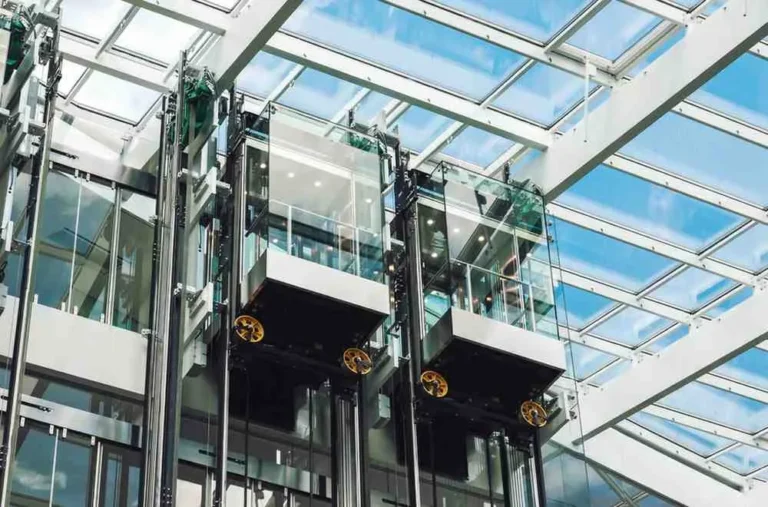
Glass elevators use a traction or hydraulic mechanism inside a tempered glass enclosure, often as a visible architectural feature on coastal or hillside homes. These start around $50,000 and can exceed $100,000 once custom framing and structural reinforcement are factored in.
What Drives the Final Price? (Cost Factors)
Number of Floors & Travel Distance
Each additional floor typically adds $8,000 to $18,000, covering extended guide rails, additional landing doors, and the safety devices required at every stop. A two-floor lift and a three-floor lift are not a linear price jump, since the third stop often requires code upgrades the first two didn’t.
Cabin Size, Load Capacity & Materials
A standard residential cab rated for 750 to 1,000 pounds costs less than a wheelchair-accessible cab rated for 1,400 pounds with reinforced flooring. Stainless steel and powder-coated aluminum resist corrosion better than standard steel, which matters more in coastal air than most homeowners expect.
Drive System Type
As shown above, hydraulic and screw-driven systems tend to be the most budget-friendly for homes under three floors, while traction systems become more cost-effective per floor as height increases. This is the single biggest lever in your final outdoor home elevator cost, more than any finish or feature.
Site Prep & Structural Reinforcement
Cutting into an exterior wall, pouring a footing, or reinforcing a deck to carry the added load can add $5,000 to $15,000. Homes on a slope or with a raised foundation often need custom framing work here, which is where quotes diverge the most between contractors.
Permits, Inspections & Code Compliance
Most California municipalities require a building permit plus a separate elevator inspection, running $500 to $2,500 combined depending on jurisdiction. San Diego County inspections also check ADA compliance details if the unit is being installed for accessibility purposes, which can add a review cycle but rarely extra cost.
Cost by Climate Zone (Why Your Location Changes the Price)
Coastal & High-Humidity Areas
Salt air accelerates corrosion on standard steel components within a few years. Coastal installations, common along La Jolla, Del Mar, and Coronado, generally need marine-grade stainless steel or specialty coatings, adding roughly $3,000 to $8,000 to the equipment cost.
Cold/Snow Regions
Homes in colder climates need heated motor housings and insulated control panels to prevent freezing, along with drainage systems that handle snowmelt at the base. These additions typically run $2,000 to $6,000.
Hot/Desert Climates
Inland and desert installations face a different problem: UV degradation of seals, gaskets, and finishes. Heat-resistant lubricants and UV-stable glazing on glass units add a smaller premium, usually $1,000 to $3,000, but skipping this step shortens the equipment’s usable life considerably.
Real 2026 Project Cost Breakdown (Line-Item Case Study)
Here’s an actual breakdown from a two-floor hydraulic outdoor elevator installed on a coastal San Diego property this year, sized for wheelchair accessibility:
| Line Item | Cost |
| Elevator unit and hydraulic drive system | $22,500 |
| Marine-grade cab finish and enclosure | $6,800 |
| Site prep, footing, and structural bracket work | $7,200 |
| Electrical panel upgrade and dedicated circuit | $2,100 |
| Permits and elevator inspection | $1,400 |
| Installation labor | $8,900 |
| Total | $48,900 |
Notice that equipment was only about 46 percent of the total here, lower than the typical 55 to 65 percent industry range, because the coastal finish requirements and structural bracket work pushed the site prep and materials portion higher than average. This is the kind of variance a generic cost range can’t show you.
Outdoor Elevator vs Indoor Elevator vs Vertical Platform Lift
| Feature | Indoor Elevator | Outdoor Elevator | Vertical Platform Lift |
| Typical Cost | $18,000 to $45,000 | $20,000 to $100,000+ | $6,000 to $15,000 |
| Weather Exposure Handling | Not applicable | Built-in requirement | Limited |
| Interior Space Needed | Yes, significant | None | None |
| Best For | Homes with spare interior footprint | Homes needing exterior access, additions | Budget accessibility, 1 to 2 floors |
| Install Complexity | Moderate | Higher, due to weatherproofing | Low |
Outdoor units generally cost 10 to 30 percent more than a comparable indoor system for the same drive type, purely because of the weatherproofing and structural work involved.
Hidden & Ongoing Costs
One-Time Hidden Costs
Concrete footing runs $1,500 to $4,000. Electrical panel upgrades add $1,000 to $3,000. If installers need to cut into siding to route wiring or frame the shaft opening, repair typically costs another $500 to $2,000.
Annual Maintenance & Running Costs
Plan on $200 to $500 per year for inspections, lubrication, and minor parts. Monthly electricity use for a residential unit is modest, usually $5 to $15, comparable to running a small window air conditioner intermittently.
Lifespan and Eventual Replacement Cost
A well-maintained hydraulic or traction elevator lasts 20 to 25 years before major components need replacement. Screw-driven and pneumatic systems, with fewer moving parts, often stretch closer to 25 to 30 years. Budgeting a small annual reserve now, roughly what you’d spend on maintenance, avoids a surprise five-figure replacement bill later.
Financing Options, Tax Deductions & Accessibility Grants
Medical Expense Tax Deduction
If the elevator is installed for a documented medical need, such as mobility limitations, a portion of the cost may qualify as a deductible medical expense under IRS guidelines, provided it doesn’t increase the home’s fair market value by the full installation amount. A tax professional should confirm eligibility based on your specific situation.
State/Local Accessibility Grant Programs
California offers several home modification assistance programs through county aging and disability resource centers, along with VA grants for qualifying veterans with service-connected mobility limitations. These programs rarely cover the full outdoor home elevator cost, but they can offset a meaningful portion for qualifying households.
Financing Through Contractors
Many remodeling contractors, including our team, offer financing arrangements that let you fold elevator installation into a broader renovation loan. This often results in a lower blended rate than financing the elevator as a standalone purchase.
DIY Installation vs Hiring a Professional
Some vertical platform lift kits are marketed as self-installable, and for a simple one-floor unit on level ground, a highly experienced DIYer might pull it off. Everything beyond that- hydraulic lines, structural load calculations, electrical code compliance, and inspection sign-off- genuinely requires a licensed contractor. Our team at San Diego Home Remodeling has been called in more than once to fix a self-installed lift that failed inspection because the footing wasn’t rated for the load. The labor savings rarely outweigh the risk of redoing structural work.
Questions to Ask Before You Sign a Contract
- What drive system are you specifying, and why is it right for my floor count?
- Is the quoted price all-inclusive of permits, electrical, and site prep, or itemized separately?
- What warranty covers the motor, cab, and structural components individually?
- How is the unit rated for my specific climate exposure?
- What’s the realistic timeline from permit approval to final inspection?
A contractor who can’t answer these clearly in the first conversation is worth a second look before you commit.
Who Actually Needs One? (Best-Fit Scenarios)
Aging homeowners without room for an interior shaft are the most typical clients we see for this upgrade, since it solves mobility needs without a full interior remodel. Multi-story coastal and hillside properties benefit from glass or enclosed units that double as a design feature. Anyone planning a larger renovation should consider bundling the elevator into a San Diego Whole Home Remodeling project, since shared scaffolding, electrical work, and permitting can meaningfully reduce the combined labor cost compared to doing each project separately.
Is It Worth the Investment? (ROI & Home Value Impact)
For accessibility needs, the value isn’t really measured in resale numbers; it’s measured in whether someone can safely stay in their home instead of relocating. For luxury coastal properties, a well-designed glass elevator can function as a distinct architectural feature that buyers notice during showings, though it rarely recoups its full cost dollar-for-dollar at resale. The more realistic return comes from combining the elevator with a broader remodel, where the total project value to a future buyer exceeds the sum of its individual upgrades.
Conclusion
Outdoor Elevator Cost in 2026 ranges from roughly $6,000 for a basic platform lift to well over $100,000 for a custom glass installation, and the honest answer for most homeowners lands between $25,000 and $55,000 once site prep, climate-specific materials, and permits are factored in. The type of drive system and your local climate conditions matter more to the final number than almost anything else on this list. If you’re weighing an outside elevator for home accessibility or planning it as part of a larger renovation, San Diego Home Remodeling can walk you through a real, itemized quote based on your property. Contact us today to schedule a site assessment.
FAQs
How much does an outdoor elevator cost on average in San Diego?
Most local installations fall between $25,000 and $55,000, depending on the drive system and floors served. Coastal properties often land at the higher end due to corrosion-resistant material requirements.
What is the cheapest type of outdoor elevator?
A vertical platform lift is the most affordable option, typically starting around $6,000 installed. It works well for one to two floors but offers limited weather enclosure compared to a full elevator.
Do outdoor elevators need more maintenance than indoor ones?
Yes, slightly. Outdoor units face weather exposure that indoor elevators don’t, so annual inspections matter more. Budget $200 to $500 per year for routine service regardless of type.
Can I add an outdoor elevator without a full home renovation?
Yes, it can be installed as a standalone project. That said, bundling it with a larger renovation often reduces combined labor and permitting costs.
How long does an outdoor elevator installation take?
A vertical platform lift typically takes one to three days. Enclosed shaft or traction elevators requiring structural work can take one to three weeks, depending on permit timelines.