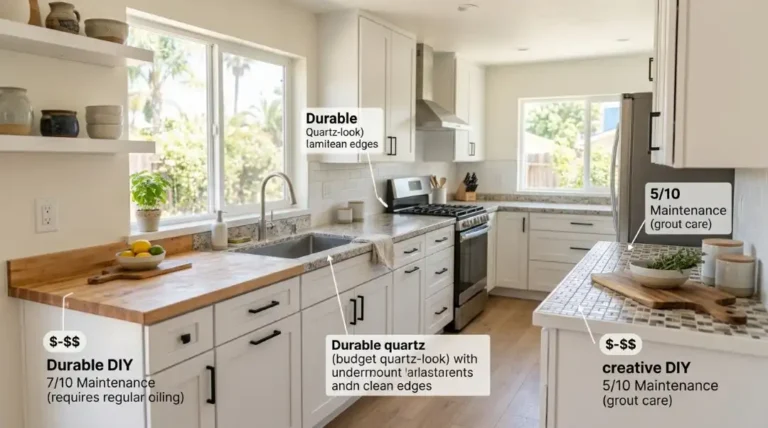
Your countertops take more daily damage than almost any other surface in your kitchen: hot pans, dropped knives, wine spills, and years of prep work all catch up eventually. When yours starts looking tired, a full replacement’s price tag can make you put the project off. Quartz now runs $70 to $100 per square foot installed in most San Diego kitchens, with granite close behind.
The good news is that inexpensive countertop ideas don’t have to mean a cheap-looking kitchen. There are countertop cheap ideas that hold up to real cooking and look genuinely polished, and at San Diego Home Remodeling, we help homeowners find them every week.
Table of Contents
Quick Answer: The Cheapest Countertop Materials, Ranked by Price
If you only have a minute, here’s the short version. Laminate is the cheapest option overall, tile comes in close behind it, and butcher block and solid surface sit in the middle of the pack.
Material | Price/Sq Ft (Installed) | Lifespan | DIY Difficulty | Best For |
Laminate | $15 – $40 | 10-20 years | Moderate | Rentals, resale flips, tight budgets |
Tile | $20 – $45 | 20-30+ years | Moderate | Homeowners who like a hands-on project |
Butcher Block | $30 – $60 | 20+ years (refinishable) | Moderate | Warm, lived-in kitchens |
Solid Surface | $40 – $65 | 15-25 years | Hard (pro recommended) | Seamless, low-maintenance looks |
Concrete (DIY) | $65 – $135 | 25+ years | Hard | Homeowners with real DIY experience |
What Is the Cheapest Countertop Material Available Right Now?
Laminate remains the most affordable countertop material you can buy today, typically running $15 to $40 per square foot installed. Modern laminate has moved well past the plain patterns from decades ago. Today’s versions can mimic marble veining, concrete, and even the flecked look of quartz closely enough that most guests won’t clock the difference from a few feet away.
Right behind laminate sits tile, which can start as low as $2 per square foot for the material alone before installation and grout work. Solid surface materials land in the middle of the pack, and they carry one real advantage: scratches and stains can usually be sanded or buffed out rather than requiring a full replacement.
If you’re weighing a full kitchen renovation rather than just the counters, our San Diego Kitchen Remodeling Services team can walk you through realistic numbers for your specific layout, including how countertop choice affects your overall budget.
Laminate Countertops: Still the Best Value for Most Kitchens

Laminate is made from layers of plastic bonded over a particleboard core, then printed with a high-resolution image of stone, wood, or another texture. It’s scratch-resistant for everyday use, wipes clean easily, and comes in hundreds of patterns.
The tradeoff is heat sensitivity. We’ve seen homeowners set a hot pan directly on a laminate counter and end up with a permanent cloudy mark within seconds, so keeping a trivet within reach matters more here than with stone. Edges can also lift over time if the original installation used low-grade adhesive, which is one reason we recommend a professional seal check every few years on older laminate.
Quartz-Look Laminate: The Closest You’ll Get to Stone for Less
If your goal is a quartz look without the quartz price, ask specifically for a high-definition laminate line. These printed patterns replicate the fine speckled texture of quartz far more convincingly than older laminate ever could, and they typically cost a third of what real quartz runs per square foot.
Peel-and-Stick Countertop Covers (Short-Term Fix)
For a genuinely temporary fix, peel-and-stick vinyl sheets run $2 to $5 per square foot and go directly over your existing counter. We only recommend these for rentals or a home you plan to sell within a year or two, since the seams tend to show and the surface won’t hold up to a decade of daily cooking.
Butcher Block: Warm, Workable, and Within Budget
Butcher block brings a warmth that no engineered surface fully replicates. Made from glued strips of hardwood, it typically runs $30 to $60 per square foot installed, putting it in direct competition with mid-range quartz alternatives on price while offering a completely different look.
The standout benefit is repairability. A deep knife gouge or a water stain that would permanently ruin laminate can often be sanded flat and re-oiled on butcher block, which means the surface can look new again years after installation. It does need regular maintenance, a few minutes of food-safe mineral oil every month or two, but that upkeep is minor compared to what it saves you in replacement costs.
Tile Countertops: Affordable, Durable, and DIY-Friendly
Ceramic and porcelain tile remain some of the most durable inexpensive countertop ideas available. Individual tiles resist heat and stains, and a properly sealed tile counter can last decades. Material costs can run under $3 per square foot at most supply stores, and a homeowner with basic tools can install one over a weekend.
Grout is where tile gets tricky. Unsealed grout traps grease and food residue in a working kitchen faster than most people expect, so we always recommend a darker grout color paired with an annual sealant application. That single step is the difference between a tile counter that still looks sharp after five years and one that looks grimy after five months.
Solid Surface Countertops: The Underrated Middle Ground
Solid surface material, made from acrylic and polyester resins, sits in a spot most homeowners overlook when they’re focused on the cheapest possible option. At $40 to $65 per square foot, it costs more than laminate but delivers a completely seamless look, since seams can be sanded invisible during installation.
What makes it worth considering is repairability combined with a premium finish. Burns, scratches, and stains can typically be buffed out on-site rather than requiring a replacement panel, which is a real advantage for a busy household kitchen. The installation itself does require a professional, since visible seams undercut the entire point of the material.
Stainless Steel and Concrete: Budget Industrial Looks
For homeowners chasing a modern, industrial edge, stainless steel panels and poured concrete are worth a look among cool cheap countertops that don’t read as budget choices once they’re installed.
DIY Concrete Countertops: What to Know Before You Pour
Concrete runs $65 to $135 per square foot professionally, but a DIY pour can cut that significantly if you’re comfortable with forming and finishing work. The catch is that concrete is unforgiving. Air bubbles, uneven curing, and hairline cracks are common on a first attempt, and once the slab is poured, there’s no easy fix. If you’re set on doing it yourself, plan a test pour on a small panel before committing to the full kitchen.
Stainless Steel Panels as a Countertop Alternative
Stainless steel panels, sometimes salvaged from restaurant supply outlets, give a kitchen a professional-grade look for a fraction of what a custom steel fabrication would cost. They resist heat and stains completely, though fingerprints and water spots show more than on other materials, so daily wiping becomes part of the routine.
Recycled and Eco-Friendly Options on a Budget
Recycled glass countertops, made from post-consumer glass set in cement or resin, deliver a speckled, colorful look that reads as genuinely high-end. Pricing typically runs $50 to $70 per square foot installed, putting it above laminate but still well under natural stone.
Paper composite surfaces, made from recycled paper and resin, are another option worth a second look. They’re heat-resistant, non-porous, and can be refinished much like butcher block. For homeowners who want a quartz alternative that’s both budget-friendly and better for the environment, this category delivers results that surprise most first-time buyers.
DIY Countertops: Where Budget Meets Effort
What You Can Do Yourself to Cut Costs
Labor typically accounts for 30 to 50 percent of a countertop installation bill, so tackling the work yourself can cut your total cost significantly. Laminate sheets, tile, and butcher block are the three most DIY-friendly categories. Laminate needs a circular saw, contact cement, and a J-roller. Tile needs a wet saw, thin-set mortar, and grout. Butcher blocks can be cut and screwed into place with tools most homeowners already own.
When to Call a Professional Instead
Concrete and solid surface are two materials where we consistently advise against a first-time DIY attempt. Concrete demands precise forming and curing knowledge, and solid surface requires specialized seam-welding equipment to hit that seamless finish. Getting either wrong doesn’t just cost you the material, it usually costs more to fix than a professional installation would have in the first place.
How to Update Countertops on a Budget Without Full Replacement
If your existing counter is structurally sound but visually dated, a full tear-out isn’t your only option. Countertop paint and resurfacing kits run under $100 and include a base coat, a decorative top coat, and a protective clear finish. Done carefully, the result can look respectable for two to four years.
Epoxy overlay systems go a step further. A two-part epoxy poured or rolled over the existing surface creates a glossy, stone-like finish. These kits run $100 to $300 for a standard kitchen and remain one of the most effective countertop cheap ideas for homeowners who want a dramatic visual upgrade without a demolition project.
5 Mistakes That Make Cheap Countertops Look Cheap
We’ve walked into more than a few kitchens where the material choice was solid but the installation choices undercut the whole look. Here’s what to avoid.
- Skipping the edge profile upgrade. A basic square edge on laminate reads as budget instantly. A bullnose or beveled edge adds minimal cost and changes the entire visual impression.
- Matching grout color to tile instead of contrasting or darkening it. Light grout on a busy kitchen counter shows every stain within months.
- Skipping sealant on tile and butcher block. This is the single most common shortcut we see, and it’s the fastest way to age a new counter by five years in six months.
- Ignoring seam placement on laminate and solid surface. A seam placed at the sink cutout or a high-traffic zone is far more visible than one tucked near a corner.
- Choosing high-gloss sheen in a busy kitchen. Glossy finishes show fingerprints, water spots, and scratches far more than a satin or matte finish, even on the exact same material.
How Long Do Budget Countertops Actually Last?
Lifespan varies more than most homeowners expect. Laminate typically lasts 10 to 20 years with normal use, though heat damage can shorten that considerably. Tile, when properly sealed, regularly reaches 20 to 30 years. Butcher block can effectively last indefinitely since it can be resanded and refinished repeatedly. Solid surface generally holds up 15 to 25 years, and concrete, when poured and sealed correctly, can outlast most other materials on this list at 25 years or more.
Real Cost Example: What a 30 Sq Ft Kitchen Countertop Actually Costs
Per-square-foot ranges only tell half the story, so here’s what a typical 30 square foot kitchen counter, roughly the size of an average U-shaped kitchen, actually costs by material once installation is included.
- Laminate: $450 to $1,200
- Tile: $600 to $1,350
- Butcher block: $900 to $1,800
- Solid surface: $1,200 to $1,950
Even at the high end, every option on this list comes in well under the cost of a quartz or granite replacement for the same footprint, which regularly starts above $2,100 for the same 30 square feet.
Why Choose Cheap Countertops? (Rental / Resale / Tight Budget Framework)
Cheap doesn’t mean low quality. Think of countertop pricing as a spectrum, not a quality ranking. A $35 per square foot tile counter installed correctly will outperform a $100 per square foot slab installed poorly, every time.
Three situations make budget-friendly countertops the smart financial choice:
- Rental properties. Tenants care whether a counter is clean and functional, not whether it’s quartz. Installing $25 per square foot laminate in a rental unit instead of stone can save thousands without affecting occupancy rates.
- Short-term ownership. If you plan to sell within three to five years, matching the neighborhood standard matters more than upgrading to premium materials. Buyers in mid-range markets notice updated counters, not the specific material behind them.
- Tight renovation budgets. Spending $1,200 on laminate instead of $3,000 on quartz frees up funds for cabinet hardware, lighting, and a backsplash, three upgrades that often do more for a kitchen’s perceived value than the counter material alone.
The Right Inexpensive Countertop Is Closer Than You Think
Replacing your countertops doesn’t have to drain your renovation budget. Whether you choose laminate for its price and versatility, butcher block for its warmth and repairability, or tile for its durability and DIY potential, there are real inexpensive countertop ideas that look polished and hold up to daily use. The key is matching the material to your kitchen’s traffic level, your maintenance tolerance, and how long you plan to stay in the home.
Get Help With Countertop Installation From San Diego Home Remodeling
Choosing the right material is only half the job. Getting it installed correctly is the other half, and a bad installation wastes good material. Uneven seams, poor substrate prep, and misaligned sink cutouts cost more to fix later than they would have cost to do right the first time.
San Diego Home Remodeling has handled countertop installations across San Diego since 2002, from budget-friendly laminate jobs to premium stone fabrication. Whether you’re after cool cheap countertops for a rental flip or a full kitchen overhaul, our team provides accurate quotes, no hidden fees, and a guaranteed completion date.
Final Thoughts
The best countertops on a budget aren’t necessarily the cheapest ones, they’re the ones that match how you actually use your kitchen. Heavy cooks need heat-resistant surfaces. Low-maintenance households should steer clear of wood and concrete. Renters and flippers rarely need to spend on quartz.
Start with your real budget, add roughly 20 percent for surprises, and choose a material that fits your cooking habits and how long you plan to own the home. Mix materials strategically, an island in butcher block with laminate everywhere else, for example, and you can land a genuinely high-end look without the high-end price.
Ready to move forward? Contact us today for a free in-home consultation, and our team will bring samples, walk you through real costs for your kitchen, and give you honest advice on which material actually fits your budget and lifestyle.
FAQs About Affordable Countertops
How much does it cost to install affordable kitchen countertops?
Installation cost depends on material and kitchen size, but laminate and tile are typically the most budget-friendly, often totaling $450 to $1,350 for an average kitchen. Handling installation yourself can lower that further, while professional labor generally adds $200 to $600 depending on complexity.
Can I update my countertops without replacing them?
Yes, epoxy overlay kits and countertop paint are both solid options for refreshing an existing surface without a full teardown. They work best on smooth, well-prepped counters and can extend the life of your current setup by several years before a full replacement is needed.
What are the best inexpensive countertop options that look expensive?
High-definition laminate in a marble or quartz pattern, recycled glass counters with their natural texture, and dark-stained butcher block are among the top inexpensive countertop ideas that read as high-end. Edge profile and finish quality matter just as much as the material itself in how premium the final result looks.
Which cheap countertop material lasts the longest?
Butcher block and tile tend to last the longest among budget materials, with tile regularly reaching 20 to 30 years when properly sealed and butcher block lasting indefinitely since it can be resanded and refinished. Concrete can also outlast most budget options if it’s poured and sealed correctly.
Do cheap countertops hurt home resale value?
Not necessarily. In most mid-range neighborhoods, buyers respond to updated, clean-looking counters rather than the specific material, so a well-installed laminate or tile counter can support resale value just as well as stone in the right market.