You’ve picked the color. You’ve moved the furniture in your head. Now comes the real question: how much does it cost to paint a room and will it blow your budget? Most people either overpay because they didn’t plan, or underpay and end up with patchy walls that peel in six months. Neither is a good outcome.
Here’s the short answer: painting a single room professionally costs between $300 and $1,200, depending on room size, wall condition, and paint quality. DIY will run you $100 to $300 in materials. This guide goes over every cost factor so you can plan your job without any surprises, whether you do it yourself or hire someone to do it.
Table of Contents
Key Takeaways
- The average cost to paint a room professionally is $300 to $1,200.
- Labor makes up 60% to 90% of your total project cost.
- A gallon of interior paint covers 350 to 400 square feet and costs $20 to $80.
- DIY saves on labor but adds 2 to 3 full days of your time per room.
- Always set aside a 10% to 15% contingency fund for unexpected wall repairs.
- Higher quality paint can mean fewer coats which directly cuts your labor cost.
How Much Does It Cost to Paint a Room in 2026?
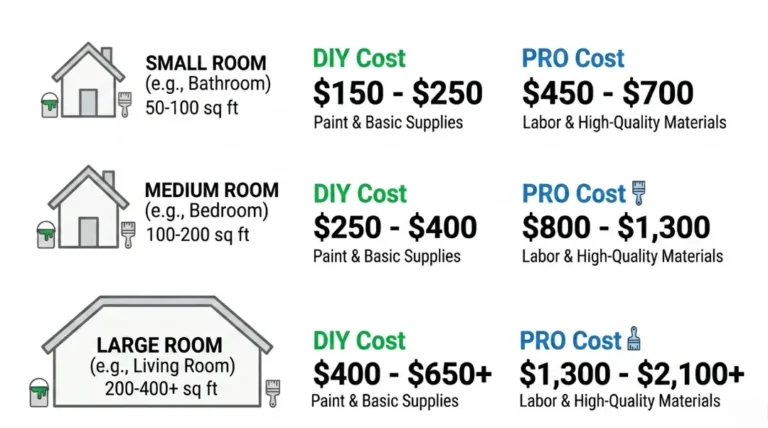
The national average sits between $400 and $1,600, with most homeowners paying around $900 to $1,100 for a standard room. That range exists because no two rooms are the same. A freshly drywalled 10×10 bedroom is a very different job from a tall-ceilinged living room with crown molding and four colors of trim.
Room Size | Approx. Wall Sq Ft | DIY Cost | Pro Cost (Avg) |
Small (10×10) | ~240 sq ft | $100 – $200 | $300 – $700 |
Medium (12×12) | ~480 sq ft | $150 – $300 | $600 – $1,200 |
Large (16×16+) | ~880 sq ft | $250 – $450 | $1,200 – $2,500 |
Painting prices per square foot range from $2 to $10 for interior walls, with the national average around $4 to $6. That number shifts based on your location. Painting a room in California typically costs more than the same job in Texas simply because of local labor rates and cost of living.
Factors That Determine Your Final Painting Cost
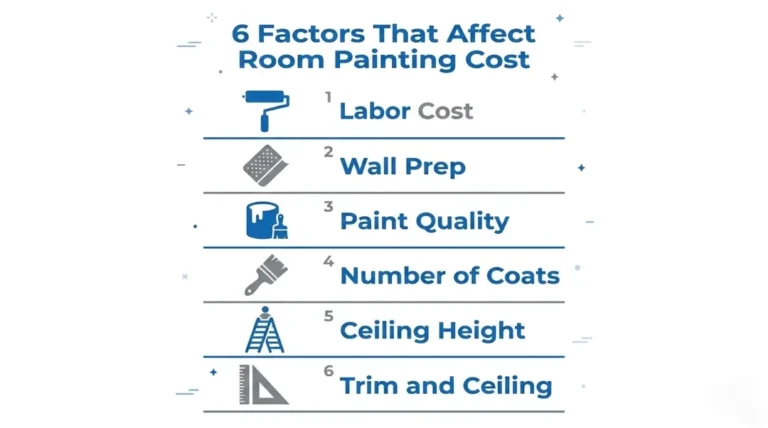
The painting quote you get isn’t random. It’s built from real, measurable variables. Understanding these helps you spot a fair price and a padded one.
Labor Cost
Labor is the biggest line item. Professional painter rates run $25 to $75 per hour, and a single room typically takes one to two full days. The more detailed the work cutting in around crown molding, painting trim, working around built-ins the more hours it takes.
Wall Condition and Prep Work
Prep work is where the real time goes. Patching holes, sanding, caulking gaps, and taping off trim can take as long as the painting itself. If your walls are in rough shape, expect the labor cost to climb. Skipping prep is how you end up with a finish that looks bad in six months.
Paint Quality and Finish
A gallon of paint ranges from $20 for economy latex to $80 for premium options. Better paint lasts longer, which means you need fewer coats of paint, which saves you money in the long run. The finish is also important. Flat and matte paints usually cost less than eggshell, satin, or semi-gloss.
Number of Coats
Most rooms need two coats of paint. Going from a dark wall to a light color? You may need a primer coat plus two topcoats to get clean coverage. Each additional coat adds both material and labor cost. A professional can advise you on this before the job starts.
Ceiling Height and Room Complexity
Standard 8-foot ceilings are straightforward. Vaulted ceilings, stairwells, or rooms with lots of architectural detail require more time and sometimes special equipment like scaffolding or extension ladders all of which add to the total project cost.
Ceiling and Trim Painting
Adding ceiling paint costs an extra $1 to $2 per square foot. Trim and baseboards add $1 to $3 per linear foot. These aren’t huge numbers per foot, but they add up fast in a large room with a lot of millwork.
The Cost to Paint a Room by Yourself
Going the DIY route saves on labor but requires a real time investment. Budget $100 to $300 in supplies for a standard room more if you need to buy equipment from scratch.
Supply Item | Estimated Cost |
Interior paint (2 gallons) | $40 – $160 |
Primer (1 gallon) | $15 – $50 |
Painter’s tape (2-inch) | $10 – $30 |
Drop cloths (plastic + canvas) | $30 – $50 |
Roller covers + brushes/rollers | $20 – $50 |
Spackle + sandpaper | $12 – $20 |
Paint tray + liners | $10 – $20 |
TOTAL (supplies only) | $137 – $380 |
If you’re starting with no equipment, add another $100 to $150 for a ladder, extension pole, and canvas drop cloths. That brings the realistic DIY cost to $250 to $500 for a medium-sized room.
Time is the real cost of DIY. A single room takes most beginners a full weekend two to three days including prep, two coats, and cleanup. A professional crew finishes the same job in one day.
The Cost to Hire a Professional to Paint a Room
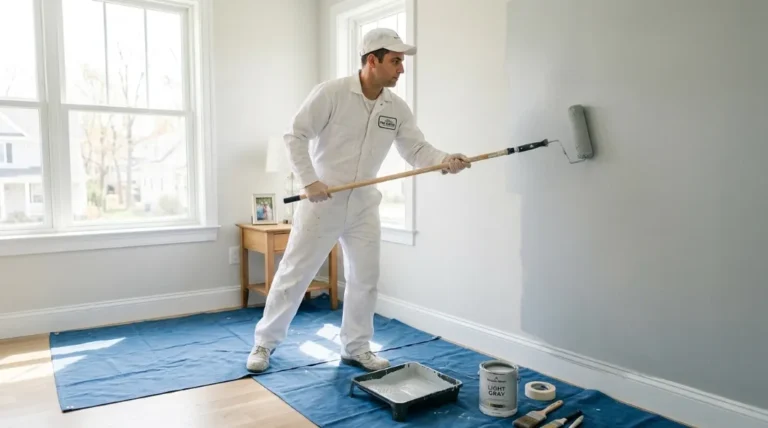
Hiring a professional painter costs between $300 and $1,200 for a standard room. That price includes labor, supplies, and cleanup. Most professional quotes are structured as a flat rate which means you know the full cost before anyone picks up a brush.
DIY | Hiring a Pro | |
Average Cost | $137 – $500 | $300 – $1,200+ |
Time Required | 2–3 full days | 1–2 days (crew) |
Finish Quality | Good (with patience) | Consistent, professional |
Equipment Included | Must buy or rent | Yes, included |
Cleanup | Your job | Included |
Touch-up Guarantee | None | Usually yes |
The gap between DIY and professional cost narrows when you factor in your time and the cost of buying all equipment. For most homeowners, the real question isn’t cost, it’s whether you want to spend your weekend painting.
Breaking Down Paint and Supply Costs
Latex vs. Oil-Based Paint
Latex paint is the standard for interior walls. It dries faster, cleans up with water, and works well in most rooms. Oil-based paint costs around $20 to $25 per quart but it’s preferred for trim and doors because it’s harder and easier to clean over time.
Paint Finish Types and Costs
Finish Type | Cost Per Gallon | Best Used For |
Flat / Matte | $15 – $50 | Ceilings, low-traffic rooms |
Eggshell | $25 – $60 | Living rooms, bedrooms |
Satin | $30 – $70 | Hallways, kids’ rooms |
Semi-gloss | $35 – $80 | Bathrooms, kitchens, trim |
Gloss | $40 – $90 | Doors, cabinets, accents |
Primer: When You Actually Need It
A primer isn’t always necessary. You need it when painting bare drywall, going from a very dark color to a light one, or covering stains. A gallon of universal primer costs $15 to $25 and covers 200 to 300 square feet. Special stain-blocking primers run $50 to $60 per gallon.
Paint Brand Comparison (2026)
Brand | Price Range / Gallon | Quality Tier |
Behr (Home Depot) | $20 – $50 | Good / Mid-range |
Sherwin-Williams | $35 – $85 | Premium |
Benjamin Moore | $40 – $90 | Premium |
Glidden | $15 – $30 | Economy / Budget |
What's the Average Timeline for Interior Painting?
A professional crew typically completes a standard room in one to two days. Day one covers prep work moving furniture, patching holes, sanding, caulking, and taping trim. Day two is the actual painting: first coat, dry time, second coat, and cleanup.
Day | Activity | Approx. Time |
Day 1 – AM | Move furniture, protect floors with drop cloths | 1 – 2 hrs |
Day 1 – AM/PM | Patch holes, sand, caulk, tape off trim | 2 – 4 hrs |
Day 1 – PM | Apply primer (if needed) | 1 – 2 hrs |
Day 2 – AM | First coat of paint on all walls | 2 – 3 hrs |
Day 2 – PM | Dry time, second coat, remove tape | 2 – 3 hrs |
Day 2 – PM | Cleanup, furniture back in place | 1 hr |
How to Plan Your Painting Budget
A good budget starts with accurate measurements. Here’s a simple three-step process.
Step 1: Measure Your Room
To find the overall perimeter, add up the lengths of all four walls. To calculate the total square footage of the walls, multiply by the height of the ceiling. Take away the windows and doors, which are around 20 square feet each. This is how much area you can paint.
Step 2: Calculate How Much Paint You Need
One gallon covers 350 to 400 square feet. Divide your wall square footage by 400 for one coat. For two coats of paint (the standard), multiply by two. Always buy 10% to 15% extra for touch-ups mixed paint can’t be returned, and water-based latex paint lasts on the shelf for up to 10 years if stored properly.
Step 3: Get Written Quotes
Never accept a verbal number. A real painting estimate breaks down labor, materials, prep work, and cleanup as separate line items. Get at least three quotes. A vague estimate is a red flag a professional painter knows exactly what each part of the job costs.
Set a Contingency Fund
Set aside 10% to 15% of your total budget for surprises. Water damage behind baseboards, hidden cracks, or a wall that needs more prep than expected these things happen. Having that buffer means you fix the problem properly instead of rushing past it.
How to Save Money on Your Painting Project
- Book during fall or winter when painters have more availability and rates tend to be more competitive.
- Doing your own prep moving furniture, removing outlet covers, and patching small nail holes yourself can save a pro one to two hours of labor.
- Let your painter buy the paint. They get contractor discounts of 20% to 40% off retail. Buying it yourself rarely saves money.
- Bundle rooms. Painting two or three rooms at once lowers the per-room cost because setup and travel time is shared.
- Choose higher quality paint. Premium paint with better coverage means fewer coats and less labor billed to you.
- Ask directly about promotions. Painters sometimes have gaps in their schedule and are open to negotiating.
How to Handle Unexpected Costs
Even a well-planned project can hit a speed bump. The most common unexpected costs are wall repairs, mold or water staining, and extra coats when covering a very dark color.
Drywall Repair
Significant cracks, holes, or water damage found during prep will be quoted separately. Minor patching is usually included in a standard estimate. Major repairs can add $100 to $500+ depending on severity. A good painter spots these during the walkthrough and tells you upfront not after.
Extra Coats and Color Changes
Painting a dark accent wall with a light neutral? You might need a coat of primer plus three topcoats to get clean, even coverage. Each extra coat adds paint and labor. Ask your painter about this during the quote stage so it’s not a surprise on the final bill.
How to Read a Painting Estimate
Your estimate should list the exact areas being painted, the type and brand of paint, the number of coats, prep work details, and cleanup. If any of these are missing, ask for them in writing before signing. A contract protects both you and the painter.
How San Diego Home Remodeling Gets Its Cost Data
The pricing figures in this guide come from real project data, not just national averages. San Diego Home Remodeling has completed hundreds of interior painting projects across San Diego County from small bedroom refreshes to full multi-room interior repaints.
We cross-reference our actual job costs against current rates from HomeAdvisor, Angi, and local contractor surveys. San Diego sits above the national average for labor costs, which is why our figures may differ slightly from guides written for other parts of the country.
If you want a number specific to your home and not a national average, the only way to get it is through a real walkthrough. Our painting services in San Diego team offers free, no-obligation estimates based on your exact room dimensions, wall condition, and project scope no guesswork required.
The Bottom Line
So, how much does it cost to paint a room? For most homeowners, the realistic answer is $300 to $1,200 for professional work, or $150 to $400 for a full DIY job. The final number depends on your room size, wall condition, paint choice, and how much prep work is needed.
The biggest mistake people make is treating paint jobs as interchangeable. A cheaper quote often means skipped prep and that’s why the finish looks bad within a year. A slightly higher budget for quality materials and honest labor pays for itself in a finish that actually lasts.
Get three written quotes, set a contingency fund, and don’t skip the prep. That’s the formula for a paint job you’ll still like in five years.
FAQs About the Cost to Paint a Room
How many gallons of paint do I need for a room?
One gallon of paint covers roughly 350 to 400 square feet. A standard 12×12 room has about 480 square feet of wall space. For two coats, you’ll need approximately two to three gallons. Always buy 10% extra for future touch-ups.
What’s the average rate for painting a room professionally?
The average cost to paint a room professionally is $300 to $1,200, or $2 to $6 per square foot of wall surface. Labor typically accounts for 60% to 90% of that total.
Is it cheaper to DIY or hire a professional painter?
DIY costs $150 to $400 in materials but takes 2 to 3 full days. Hiring a pro costs $300 to $1,200 but is done in one to two days with a cleaner finish. Once you factor in your time and equipment, the cost gap closes fast.
Do I need to prime before painting?
Not always. Primer is required when painting bare drywall, going from dark to light colors, or covering stains. In most refresh situations of the same color or a similar tone a good-quality paint with built-in primer is sufficient.
What’s the difference between a painting estimate and a contract?
An estimate is a detailed proposal breaking down labor, materials, and scope of work. A contract is the signed agreement that locks in those details, the payment schedule, and the project timeline. Never start a job without both.
How do I avoid surprise charges on a painting job?
Get an itemized written quote. Disclose any wall damage, stains, or unusual features before the job starts. Ask your painter exactly what is and isn’t included in the prep work. That conversation upfront prevents a much bigger one at the end.